
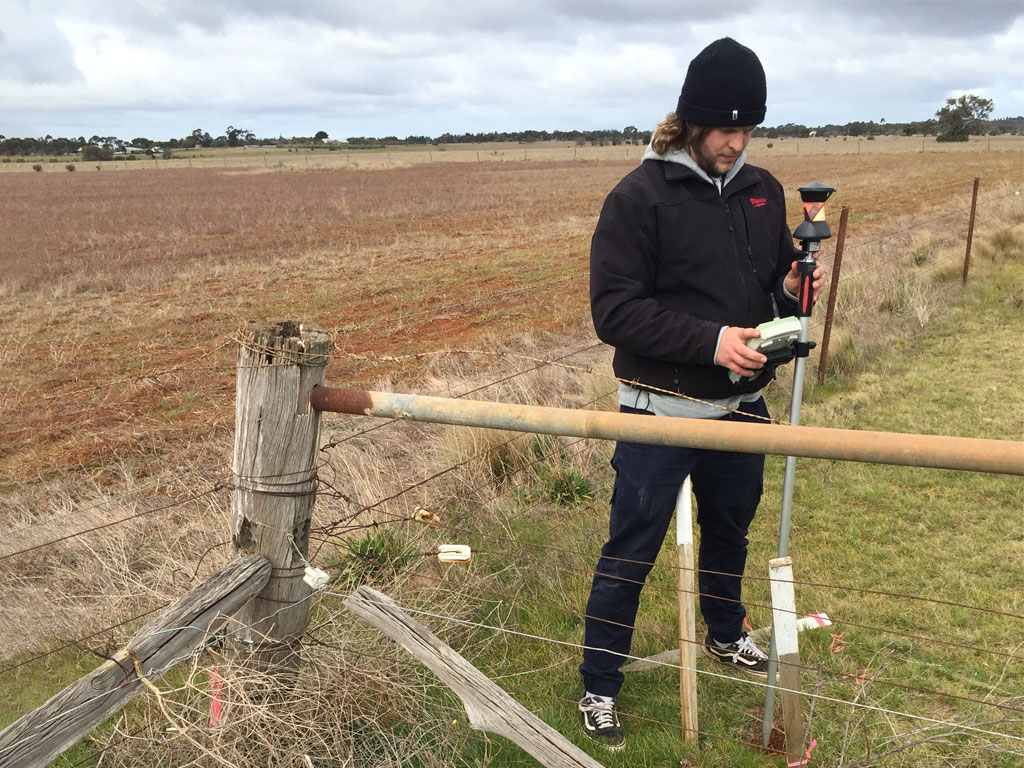
Short answer: a fence boundary survey is when a licensed land surveyor works out exactly where your title boundary is and marks it on the ground, so you and your neighbour know where a dividing fence should go. In Geelong and across Victoria, fences are often not on the true boundary, and a fence boundary survey is the quickest way to settle the question before you build, replace a fence or get drawn into a dispute.
Whether you own a house in Newtown or Belmont, a new block in Lara or Ocean Grove, or a farm near Colac, here is what a fence boundary survey in Geelong involves and how it fits with Victoria’s fencing laws.
Why fences are often not on the title boundary
Most people assume the fence marks the edge of their land. Often it is close, but not exact, and sometimes it is well out. Common reasons include:
- Old titles and old surveys. Many older parts of the region, including inner Geelong, Queenscliff and Point Lonsdale, were first surveyed long ago with the equipment of the day. Fences built from those early marks can be out by a noticeable amount.
- Fences replaced on the old line. When a fence is rebuilt, it is usually put back exactly where the old one stood, so any original error carries forward for decades.
- Convenience on rural land. Farm fences are frequently run along creeks, gullies, tree lines or the easiest ground rather than the surveyed boundary.
- Missing marks. Survey pegs get pulled out during earthworks or landscaping, and fences are then placed by eye.
A small difference may not matter day to day, but it matters when you are building near the boundary, subdividing, selling, or sharing the cost of a new fence.
When should you get a fence boundary survey in Geelong?
It is worth getting the boundary confirmed by a licensed land surveyor when:
- you are planning to replace or build a dividing fence and want it in the right place this time
- you and your neighbour disagree about where the boundary is
- you are planning a garage, extension, retaining wall or pool close to a boundary
- you are buying a property and the fences look out of line with the title plan
- you are subdividing or developing
How Victoria’s fencing law deals with boundary disagreements
In Victoria, the Fences Act 1968 sets out how neighbours agree on dividing fences, how a fencing notice works and how costs are usually shared. It also has a process for when neighbours cannot agree on where the common boundary is. In general terms:
- One owner can give the other a written boundary survey notice, either with a fencing notice or afterwards, stating where they believe the boundary is.
- The neighbour has 30 days to agree, put forward their own position, or engage a licensed surveyor.
- If the matter is still not settled, the owner who gave the notice can engage a licensed surveyor to define the common boundary and must then tell the neighbour the result.
- The reasonable cost of the survey is generally shared equally, although there is an exception where the survey confirms the position the neighbour put forward.
The Dispute Settlement Centre of Victoria offers free mediation for fencing disagreements, and the Magistrates’ Court can make orders if neighbours still cannot agree. The details matter, so check the official Victorian Government guidance or get legal advice before relying on the process. This article is general information, not legal advice.
What the law does make clear is the surveyor’s role. Under the Surveying Act 2004 (Vic), only a licensed surveyor can define title boundaries, so a boundary marked out by a fencing contractor, a builder or a neighbour with a tape measure does not settle the question.
What the land surveyor actually does
1. Title and plan research
The surveyor obtains your title, plans and survey records through Land Use Victoria, plus neighbouring records where they help. These show your land’s dimensions and the marks earlier surveyors relied on.
2. Measuring on site
Using a total station or GNSS equipment, the surveyor measures existing survey marks, fences, walls and buildings, both on your land and nearby. Old pegs and long-standing occupation can provide important evidence of where the boundary was originally set.
3. Working out the boundary
The measurements are compared with the title dimensions and the historical surveys. This is the professional judgement part of the job, and it is why a title re-establishment survey has to be done by a licensed surveyor.
4. Marking and reporting
The boundary corners or offsets are marked on the ground so a fencer can work from them, and you receive a plan or report showing where the existing fences sit in relation to the title boundary.
What if the fence is in the wrong place?
If the survey shows the fence is off the boundary, you have options. Often neighbours simply agree to build the new fence on the surveyed line. Sometimes they agree, in writing, to leave a fence where it is. Where a fence has been out of position for many years, questions about adverse possession can arise, and that is the time to get legal advice. Our earlier article on solving problems with an adverse possession survey explains how surveys are used in those situations.
What affects how long a fence boundary survey takes
Every job is different, so quotes are prepared for the specific property. The main factors are:
- the age of the title and how many usable survey marks remain nearby
- the number of boundaries and corners you need marked
- the size of the land, especially rural blocks around Colac, Ballarat or the Surf Coast hinterland
- access, vegetation, and whether neighbouring land needs to be entered
- whether the records agree with what is on the ground, or need extra investigation
Tips before you talk to your neighbour
- Get the facts first. A survey turns a disagreement about opinions into a conversation about a measured line.
- Talk early. Let your neighbour know you are having the boundary surveyed. Many disputes never start once both sides see the result.
- Keep everything in writing, including any agreement about where the fence will go.
Book a fence boundary survey with Geelong Land Surveyors
Geelong Land Surveyors marks title boundaries for homeowners, farmers, fencers and builders across Geelong, the Bellarine including Drysdale, the Surf Coast, Lara and Ballarat. For a quote, send us your property address and a short note about the fence through our contact page, or call 0412 722 261.
Frequently asked questions
Who can tell me where my boundary is?
In Victoria, only a licensed surveyor can define title boundaries. A fencing contractor or builder can put a fence on a line, but they cannot legally determine where the boundary is.
Is the fence always on the boundary?
No. Fences are often slightly off the title boundary, and on older or rural properties the difference can be larger. A survey is the only reliable way to know.
Who pays for a boundary survey in a fence dispute?
Under the Fences Act 1968 (Vic), the reasonable cost of a survey arranged through the boundary survey notice process is generally shared equally, with some exceptions. If you arrange a survey yourself outside that process, you normally pay for it. Get legal advice for your situation.
Can the survey be used for a new fence straight away?
Yes. The surveyor marks the boundary corners or offsets on site, so your fencer can build on the correct line. Protect the marks until the fence is finished.